📝 Blog
RCJ analysis, field notes, and perspectives on rural healthcare
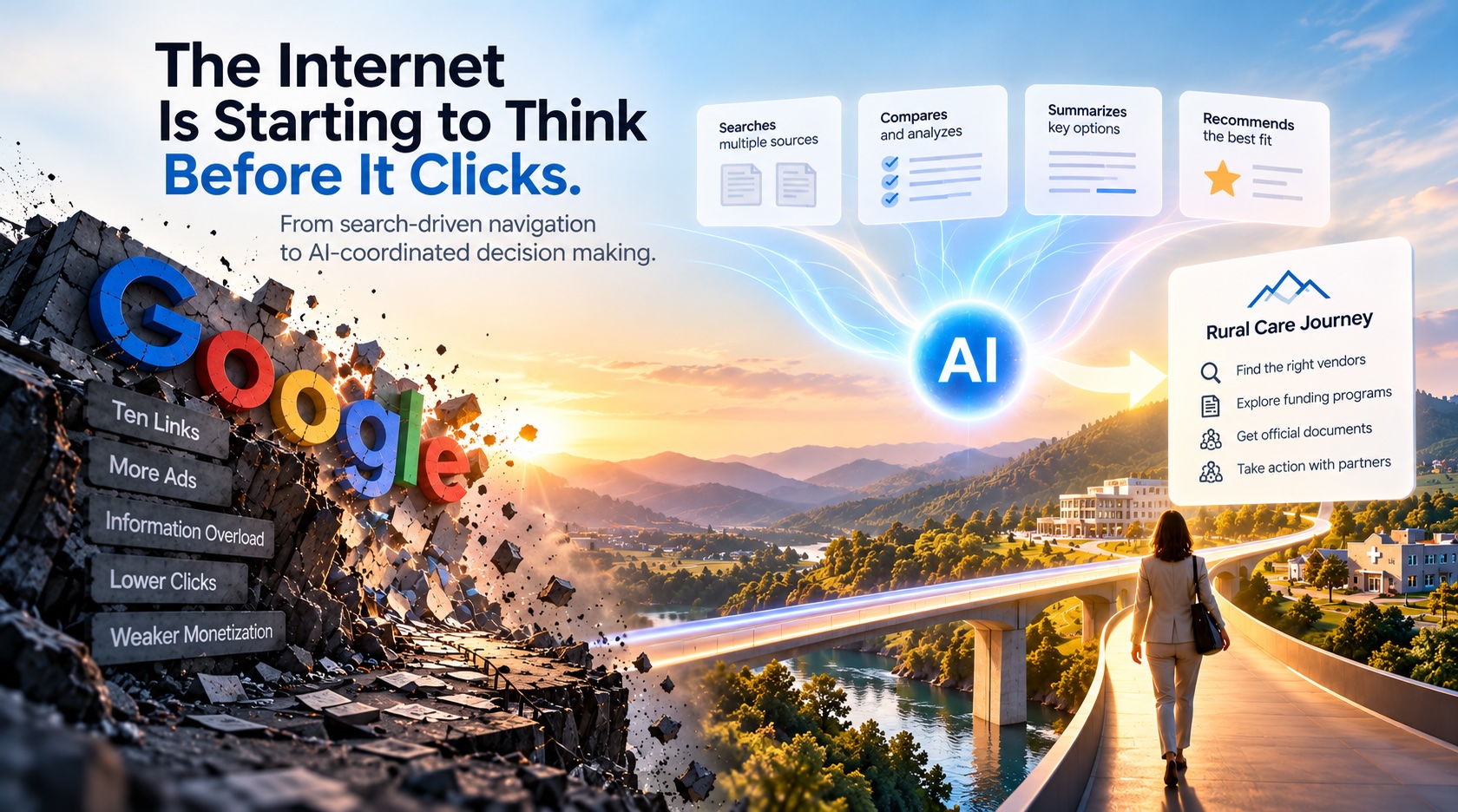
For more than two decades, Internet discovery followed a familiar path: Search → Links → Clicks → Website Google became one of the world's most valuable companies by organizing that journey better than anyone else. But AI is beginning to change the sequence. Instead of searching through ten pages, people can now ask: Which rural health funding programs are open right now? Which vendors could support this initiative? What are the most important requirements in this RFA? AI can search, read, compare, summarize and recommend before the person ever reaches a website. That leads to three hypotheses about where Internet discovery may be heading. 1. Search isn't disappearing. Its economic model is changing. Google Search remains enormous. Search activity is still growing. That is exactly why the transition is so interesting. The traditional search model is remarkably efficient: Question → results → advertising → clicks. AI changes that interface. Instead of simply presenting links, AI can interpret the question, read multiple sources, compare alternatives and recommend what should happen next. The intent has not disappeared. But more of the decision is happening before the click. Search organized links. AI increasingly organizes decisions. 2. AI may send fewer visitors — but those visitors may be more valuable. Traditional search is extremely good at generating traffic. But many of those visitors are still exploring: they search, open multiple tabs, compare information, read several pages, and then decide what matters. AI can perform part of that work before a visitor reaches the destination. Someone arriving from an AI assistant may already understand the problem, know the available choices and have a specific reason for visiting. This suggests that AI traffic should not be evaluated purely by volume. A more useful question may be: What do AI referred visitors actually do after they arrive? Fewer clicks may not necessarily mean less value. They may mean higher intent per click . 3. RCJ may already be seeing the first small signal. Rural Care Journey is still early in measuring this behavior. Our current first touch dataset includes only 116 AI attributed human readers . That is far too small to declare a trend. Among those readers, RCJ recorded: | Action | Count | Per 1,000 AI readers | | | :| :| | Registrations | 7 | 60.3 | | CTA visitors | 3 | 25.9 | | Application starts | 2 | 17.2 | | Opportunity saves | 1 | 8.6 | These actions overlap and should not be added together. The sample is small and directional, not statistically conclusive. But it supports a hypothesis worth testing: AI may generate lower referral volume while producing more intentional human visits. The better question is increasingly: How many qualified actions occurred per 1,000 AI referred readers? We're already building for this future Find vendors with AI The traditional directory asks you to browse hundreds of companies and decide which ones might fit your needs. The AI driven version starts somewhere else: What are you trying to accomplish? Describe the problem and let RCJ help narrow the vendor landscape. Try AI Vendor Search Research the RHTP landscape with AI Traditional research often means moving between state websites, funding notices, PDFs, program descriptions and opportunity pages. RCJ Research Intelligence is experimenting with a different experience. Ask the question first. Then let the system search across RCJ's structured information and underlying source material. Try RCJ Research Intelligence These are early experiments, but they represent a larger shift. The traditional website says: Here is our information. Find what you need. The emerging AI driven platform says: Tell us what you're trying to accomplish. Let's find the answer. The question for websites is changing For years, organizations asked: How high do we rank on Google? That will remain important. But another question is emerging: When an AI is asked a question in our field, does it know us, trust us and use our information? And then: When that AI sends someone to us, are they ready to act? Google is not disappearing. Search is not disappearing. The click is not disappearing. But AI is increasingly moving into the space between human intent and the Internet . The most valuable websites may not simply be the sites generating the largest number of visits. They may be the sources AI trusts before the click — and the platforms capable of turning that handoff into action. The Internet may simply be learning to think before it clicks.