← 💬 General
Recap: Navigating the RHTP Ecosystem — Technology & Telehealth Opportunities
RCJ Team· 9d ago
Thanks to everyone who joined Thursday's webinar — and to Solutionz and Telemedicine.com for co-hosting. If you missed it (or want the highlights), here's a recap.
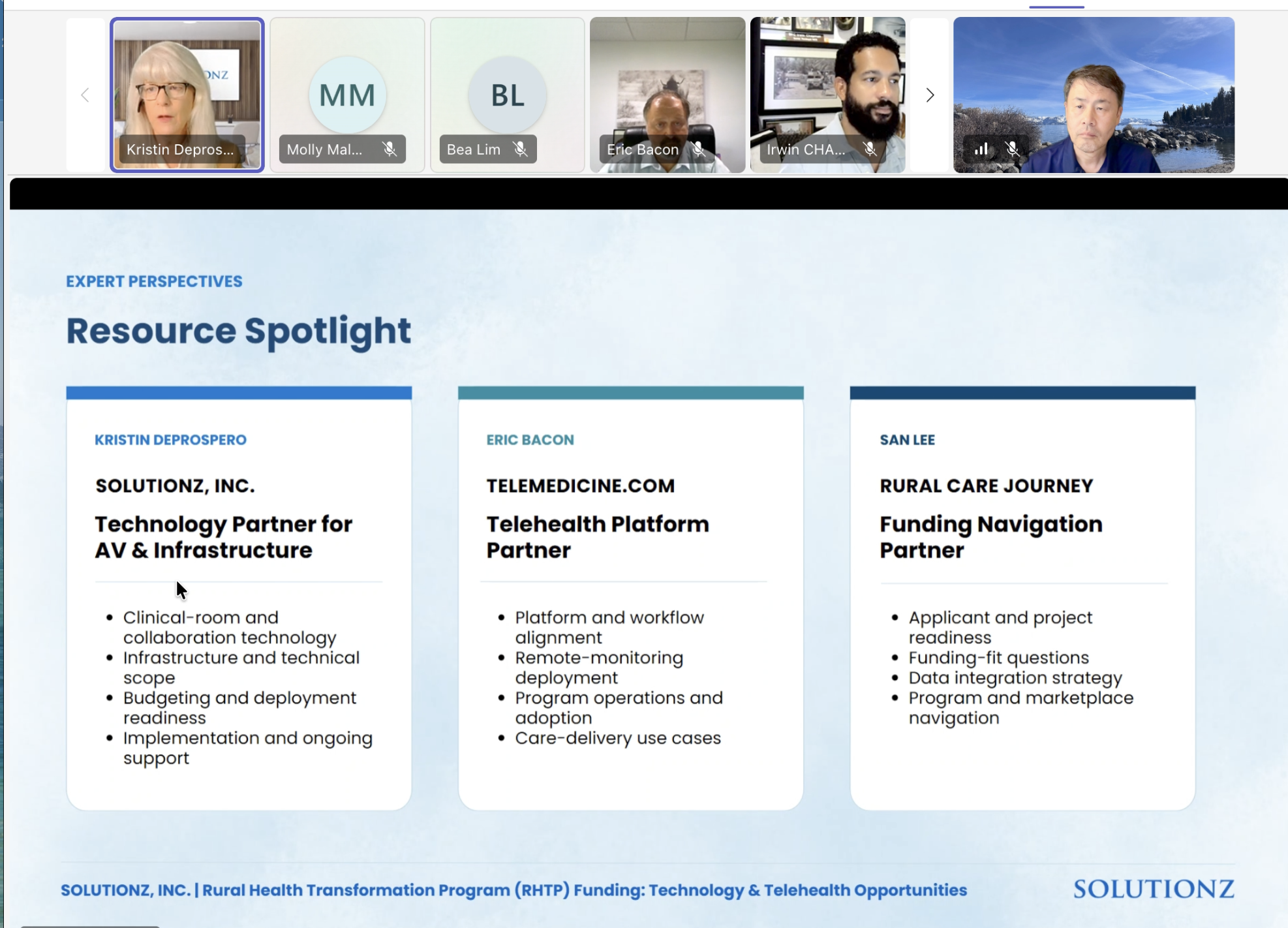
The panel: Kristin Deprospero (Solutionz — AV/telehealth infrastructure, connected care, simulation technology), Eric Bacon (Telemedicine.com — end-to-end clinical telemedicine programs since 2008), and San Lee (Rural Care Journey).
The big picture
RHTP only works when four groups move together: funders, technology vendors, applicants/consultants, and the rural providers actually delivering care. Most state RFAs are landing with 2–3 week windows, which means the prep work — project concept, partners, budget, internal sign-off — has to happen before the RFA drops, not after.
A show-of-hands poll backed this up: 67% of attendees are still just exploring RHTP, 17% have applied, and 16% are already funded and implementing. Meanwhile states had roughly 52 days to build entire program structures around ~$200M in annual federal allocations — so readiness is lagging the timeline pressure.
What actually makes telehealth programs work
Eric's core warning: don't bolt on a new app that lives outside your existing EHR and clinical workflow. Technology that adds friction gets abandoned even when it's good tech. The fix is building a multidisciplinary implementation team — clinical, technical, operational, executive — before you pick a vendor, not after.
Recurring high-demand use cases across states: virtual specialty access, behavioral health, remote patient monitoring, EMS telehealth, care coordination, mobile care, and community health pods.
RCJ platform walkthrough (Virginia example)
San walked through how RCJ maps a state's RHTP landscape — Virginia's ~$190M federal allocation and ~$44M distributed across active opportunities, plus three tools:
- Eligibility Checker — surface compliance gaps against a state's specific requirements
- AI Narrative Assistant — reads an RFA and helps draft a proposal narrative aligned to it
- Vendor Matchmaker — matches a project narrative against RCJ's vendor directory (~766 vendors at demo time)
Also covered: filtering the vendor directory by state, technology vs. consulting vs. nonprofit/CBO, and capability fit.
Open Clinic: rural EMS and OB access
One of the more concrete discussions of the day — as rural hospitals close OB units, EMS crews increasingly handle emergency deliveries without easy access to specialist trainers. The idea floated: several smaller EMS agencies pooling resources for mobile simulation equipment, neonatal resuscitation mannequins, and shared traveling-instructor / virtual-specialist support, instead of each agency buying equipment it can't really afford alone. Virginia was named as facing the same OB-desert problem.
Where the money's going
Three technology pillars keep showing up across state RHTP opportunities:
- Remote care access — telehealth, virtual specialty care, mobile health, RPM
- Connected clinical spaces — AV infrastructure, standardized telehealth rooms, device integration
- IT foundations & cybersecurity — network modernization, EHR integration, interoperability, data exchange
Winning the award is step one
James Chapp (Ono Logic) made the point that an award is the start of the work, not the finish line — implementation capacity, workflow integration, and clinical adoption determine whether a funded project actually delivers. A second poll backed this up: attendees named defining project scope and timing/deadline pressure as their top two bottlenecks.
For CAHs unsure where to start: pull together CEO, CMO, CFO, clinical, ops, and IT, and work backward from a real gap-analysis — what problem, what outcome, what capability gap, what's actually allowable under your state's RFA — rather than picking a technology first.
Takeaways
- Start building your team and partnerships before the RFA is released — the windows are too short to do it after.
- Let the clinical/operational problem drive technology selection, not the other way around.
- New systems need to plug into your existing EHR and workflows, or adoption stalls.
- A win is only as good as your ability to actually implement it.
- Regional/shared resourcing can put otherwise out-of-reach capability (simulation equipment, virtual specialists) within reach for smaller rural organizations.
Want to keep the conversation going? Drop your state or your project bottleneck below — happy to point you at relevant open opportunities or vendors in the directory.
Presenting organizations: Solutionz · Telemedicine.com